Supply Chain Exception Management

    Supply Chain Exception Management

    Handle supplier exceptions at a scale previously reserved for the top of town.
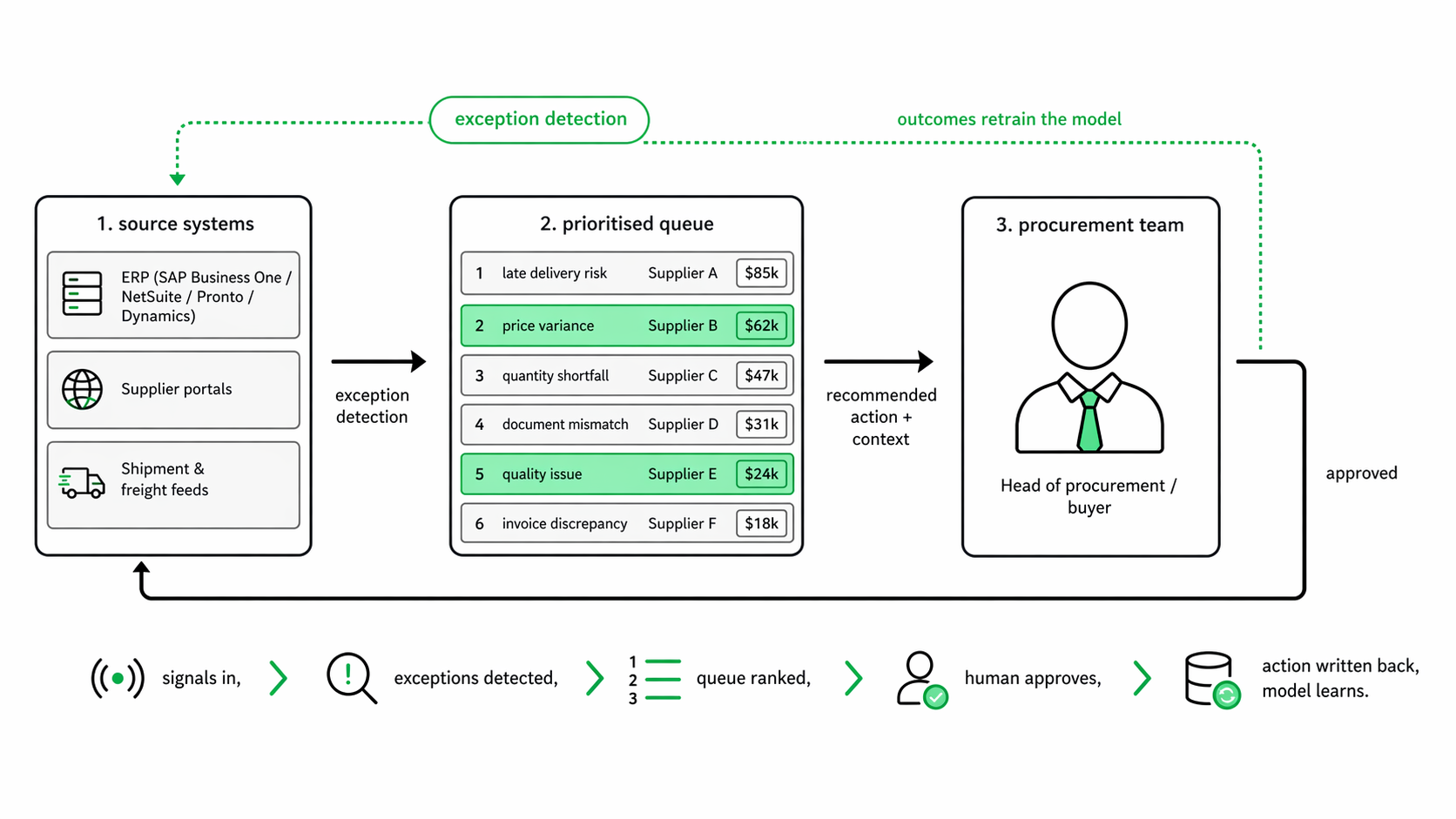
    Supply Chain Exception Management architecture diagram

    Supply Chain Exception Management is an AI orchestration layer that sits on top of your ERP, supplier portals, and shipment feeds, detects exceptions as they happen, and routes them to your procurement team as a prioritised queue with recommended actions. It is built for mid-market wholesalers, manufacturers, builders, and healthcare groups whose procurement team spends half the week chasing suppliers.

    The Problem

    What usually breaks

    Coles and Bunnings run supplier exception management with 50-person teams and bespoke platforms that cost millions. That was the only way to do it properly. Until recently.

    Most mid-market procurement teams run the same process with four people and an inbox. A shipment is late. A price on the invoice does not match the PO. A box arrives with the wrong part number and nobody flags it until production stops. The signals are all there, scattered across the ERP, the supplier portal, a freight tracker, and the email thread with the rep. Nobody has time to stitch them together before the problem lands in the warehouse.

    The cost is invisible until you look. Half a buyer's week goes on chasing. A stock-out on an A-line costs more than the buyer's salary. A freight cost blow-out nobody caught eats the margin on the quarter. The team is not bad at their job. They are running an exception-handling operation with no exception-handling system.

    In Your Business

    How this lands inside your operation

    The exception detection agent reads from SAP Business One, NetSuite, Pronto, or Microsoft Dynamics, alongside your supplier portals and the carrier feeds from Toll, StarTrack, or whoever moves your freight. It matches shipment data against POs in near-real-time. When something breaks the rules you set, it writes a case, attaches the context (the PO, the supplier, the last three exceptions from the same vendor, the downstream impact on production), and drops it into a queue ranked by cost and urgency.

    Your head of procurement opens one screen in the morning. Twelve exceptions. The top three have recommended actions already drafted. Approve, adjust, or reject. The approved action writes back to the ERP. The team is negotiating by 10am, not chasing until 5pm.

    This is for you if…

    • You are a head of procurement or COO at a mid-market manufacturer, wholesaler, builder, or healthcare group
    • Your procurement team is small (two to ten people) and spends half the week chasing
    • You run an ERP (SAP Business One, NetSuite, Pronto, Microsoft Dynamics) and your data is roughly trustworthy
    • Exceptions cost you real money and you cannot name the number
    • You want the Coles-style exception operation without the Coles-sized team

    This probably isn't the right fit if…

    • You are looking for an ERP replacement. This sits on top of what you have, it does not replace it
    • You have fewer than 50 POs a month. The economics do not work below that volume
    • Your source systems are so broken that no signal is trustworthy. Fix the foundations first
    How It Works

    The engagement, step by step

    1. 1

      Discovery maps your exception types, signal sources, and the approval rules that already live in people's heads.

    2. 2

      We connect to your ERP, supplier portals, and shipment feeds through the AIS without disturbing the source systems.

    3. 3

      The detection agent runs against live data. Every exception gets a case with cost impact and supplier context attached.

    4. 4

      Cases land in a prioritised queue. Recommended actions are drafted from your historical playbook.

    5. 5

      Your procurement team approves, adjusts, or rejects. The action writes back to the ERP automatically.

    6. 6

      Outcomes feed back into the model. The queue gets sharper on your exceptions every month.

    Exception catalogue

    Exception types we auto-detect

    Exception typeSignal sourceRecommended actionWho approves
    Late shipmentCarrier feed vs PO ETAChase supplier, flag downstream stock riskBuyer
    Short deliveryGoods receipt vs PO quantityRaise credit, trigger backorder, alert warehouseBuyer
    Price variance vs POInvoice vs PO lineHold invoice, request credit noteAccounts payable lead
    Quality failQA log vs inbound batchReject batch, log supplier defect, raise RMAQA manager
    Substitute part deliveredGoods receipt vs PO SKUAccept with engineering sign-off or rejectHead of procurement
    Early delivery, no storageCarrier ETA vs warehouse capacityDefer inbound or arrange overflowWarehouse manager
    Supplier invoice mismatchAP system vs ERPQuery supplier, hold paymentAccounts payable lead
    Freight cost blow-outFreight invoice vs quoted rateChallenge invoice, re-tender laneHead of procurement
    Outcomes

    What changes once this is in

    Response time from days to hours

    Exceptions that used to surface three days after the shipment arrived now land in the queue within minutes of the signal. Procurement acts while the supplier can still fix it.

    Supplier performance defensible in contract reviews

    Every exception is logged, costed, and attributable. Annual contract reviews stop being a feelings conversation and start being a spreadsheet with the vendor's name on it.

    Procurement workload shifts from chasing to negotiating

    Typical teams reclaim 30 to 50% of the buyer week previously spent stitching systems together. That time goes into supplier negotiation, category strategy, and the work nobody has got to.

    Fewer downstream stock-outs and stoppages

    Catching a short delivery on Monday morning, not Thursday afternoon, is the difference between a phone call and a production halt. Downstream disruption drops measurably inside a quarter.

    Common Questions

    Frequently asked

    Let's talk about Supply Chain Exception Management.

    30-minute call, no slides, no obligation. We'll tell you plainly whether this is the right fit for what you're trying to do.

    Cookie preferences

    We use essential cookies to run the site. With your permission, we also use analytics cookies to understand what content helps visitors make better data and AI decisions.