Measured against the pre-launch baseline on the same rep cohort, typically visible within the first quarter of full rollout.
Agents stop guessing. A six-week-old rep with a good recommendation outperforms a tenured rep relying on memory and product cheat sheets.
Customers receive one relevant recommendation at the moment of contact, not five generic ones in the monthly email. Opt-out rates on marketing comms fall alongside.
Every accept and decline is training data. The model gets sharper every week it runs. This is the feedback loop that separates an Insight-to-Action System from a one-shot pilot.
A recommendation engine that tells reps and agents the single best product, service, or offer for each customer right now, grounded in that customer's own transaction history. It embeds in the CRM or service desk, surfaces one action with a one-line reason, and learns from every accept, decline, or snooze. Designed for mid-market businesses with a CRM, a billing or policy system, and agents who want something better than head-office scripts.
The big-four version of this costs $8M over two years. A data science team of 30, a Martech stack that takes a quarter to reconfigure, and a real-time decisioning platform with a licence fee north of seven figures. That is not the mid-market version. The mid-market version is smaller, cheaper, and lands faster, because the data volume is smaller and the channels are fewer.
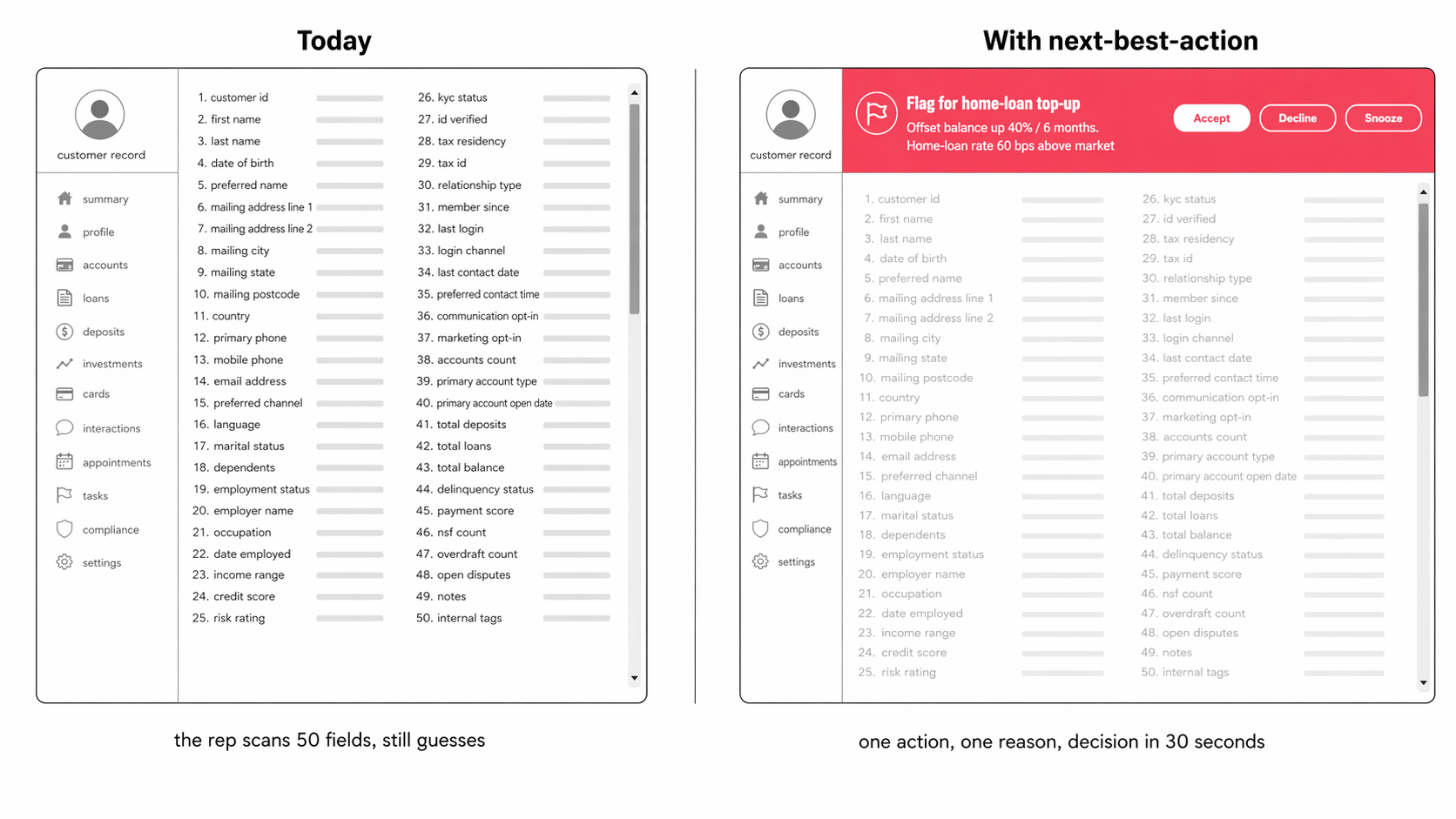
What the buyer has today is usually one of two things. Either head office sends out a monthly campaign that treats every customer like the same customer, and reps ignore it. Or the CRM shows the rep a profile page with 50 fields, and the rep clicks through maybe four of them before the call ends. Both are guessing, just at different volumes.
The gap in the middle is where mid-market banking, insurance, telco, distribution, and aftersales businesses lose cross-sell revenue every week. One relevant recommendation, delivered at the moment of contact, closes that gap.
The recommendation appears inside Salesforce on the account record itself, one banner at the top. When a relationship manager at your credit union pulls up a member for their quarterly call, the CRM shows a single prompt: "Flag for home-loan top-up. Offset balance up 40% over six months, home-loan rate 60 bps above market." Three buttons: accept, decline, snooze. That is it. No extra tab, no separate portal, no weekly PDF.
Behind the banner sits a model trained on your own transaction, policy, and service history, scoring every customer every night and picking the one action most likely to land. Every accept, decline, and snooze feeds back into tomorrow's score. The model learns which recommendations your reps actually trust. That feedback loop is the difference between a model that compounds and one that decays.
One row per sector. The recommendation is the single action a rep or agent sees on screen. The reason is the one line that sits under it.
| Industry | Example next-best action | Reason line the rep sees |
|---|---|---|
| Credit union | Flag for home-loan top-up | Offset up 40% over 6 months, rate 60 bps above market |
| Retail bank | Offer offset-linked savings sweep | $18k sitting in transaction account above 90-day average |
| General insurance | Review sum-insured for CPI uplift | Building sum insured unchanged 4 years, CPI +19% |
| Health fund | Suggest extras upgrade pre-renewal | Two dental claims declined this year against base cover |
| Telco | Move to family plan | Second active SIM on same billing address, out of contract |
| B2B distribution | Add high-margin complement to next order | Core line reordered weekly, complement attached on 62% of similar accounts |
| Automotive aftersales | Book brake-pad service at next log-book visit | Pad wear indicator at 3.2mm, next service due in 900km |
| Membership business | Offer loyalty tier upgrade | Three cross-category purchases in 60 days, spend above tier threshold |

Two frames side-by-side.
Left frame, labelled "Today". A standard CRM customer record. 50 fields visible. Name, date of birth, address, phone, email, products held (six lines), balances, renewal dates, recent interactions, notes, segment codes, marketing flags, contact preferences, household link, advisor assignment. A scroll bar on the right. The rep's eye is somewhere in the middle. Nothing is highlighted.
Right frame, labelled "With next-best-action". The same CRM, same header, but one banner has moved to the top of the screen. Inside the banner: the action ("Flag for home-loan top-up"), one line of reason ("Offset balance up 40% over six months, home-loan rate 60 bps above market"), and three buttons: Accept, Decline, Snooze. Below the banner, the customer record is still there for anyone who wants to scroll. Most won't need to.
Caption under both frames: "Same data. Same CRM. One decision the rep can actually make in the 30 seconds before the call connects."
Map your customer data: transactions, policies, products held, service interactions, and the actions reps currently log.
Stand up the AIS if needed, or connect to your existing platform, so the model has one clean view of each customer.
Train an initial recommendation model on 12-24 months of history, tuned to your product catalogue and margin profile.
Embed the recommendation as a single banner in the CRM, service desk, or call-centre screen reps already use.
Launch to a pilot team with the three-button interaction: accept, decline, snooze, each with a one-line reason captured.
Close the loop weekly: accepted actions update the model, declines and reasons retrain the ranker, snoozes recycle.
Expand to the full field once accept rates and revenue lift hold up against the baseline agreed before launch.
Predictive models, recommendation systems, forecasting, and MLOps, delivered with a ruthless ROI focus.
Learn moreProduction-ready AI agents, chatbots, and multi-agent systems, built senior-led end-to-end.
Learn moreThe operating layer your AI, automation, and analytics run on. Deployed in two weeks.
Learn moreScore every lead and account by likelihood to convert, then push the ranked list into the CRM your reps already open.
40%
YoY revenue lift, same sales team
Know which customers are leaving 30 to 90 days before they do, and what to do about each one.
10–25%
reduction in voluntary churn within 12 months
Ask your business a question. Get a cited answer before the meeting ends.
Minutes
from question to cited answer, across 29 sites
30-minute call, no slides, no obligation. We'll tell you plainly whether this is the right fit for what you're trying to do.
Cookie preferences
We use essential cookies to run the site. With your permission, we also use analytics cookies to understand what content helps visitors make better data and AI decisions.